Hocking Hills vs Red River Gorge for Cabin Investors
Hocking Hills vs Red River Gorge for cabin investors: the established giant, or the value play with bigger cliffs. The public land that anchors the Gorge’s draw is managed as part of the Daniel Boone National Forest.
The Short Answer
Hocking Hills is the established giant — a mature cabin-rental market close to Columbus with deep brand recognition and, generally, prices that reflect it. The Red River Gorge is the value-and-character play — bigger cliffs, a national climbing destination, and a younger rental market where entry costs have historically run lower. Neither is simply better: one sells proven demand at a proven price, the other sells room to grow with more work and more uncertainty.
Two sandstone markets, one buyer pool
Both regions sell the same product — a cabin in carved sandstone country within a tank of gas of the Ohio metros — which is why Columbus and Cincinnati money weighs them against each other constantly. But they’re at different points in the market cycle. Hocking Hills has decades of cabin-tourism infrastructure and name recognition; the Gorge is the younger market with the more dramatic terrain and, for now, the lower barrier to entry. This page lays out the trade honestly; my investment guide covers the Gorge side in depth.
Drive times from the Ohio metros
From Columbus, Hocking Hills is the easy winner — roughly an hour southeast, close enough for last-minute weekenders, while the Gorge runs closer to three. From Cincinnati the picture flips to near-even: both destinations sit in the two-to-two-and-a-half-hour band depending on traffic and where in the metro you start, so Cincinnati owners choose on character and price rather than windshield time. My Cincinnati corridor guide walks that specific drive. Louisville and Lexington money, for obvious reasons, tilts Gorge.
Market maturity versus entry price
Maturity is Hocking’s real asset: an established guest funnel, professional management depth, and comparable sales deep enough to underwrite against. You pay for that certainty — cabin prices there have generally been bid up by years of proven revenue. The Gorge offers the other side of the trade: entry prices that have historically run lower, less competition per listing, and a growth story tied to climbing tourism — but thinner comps, a shallower services bench, and more owner effort to stand a rental up. I won’t pretend the numbers on either side hold still; the dated, sourced figures for this market live on my market report.
Terrain and season character
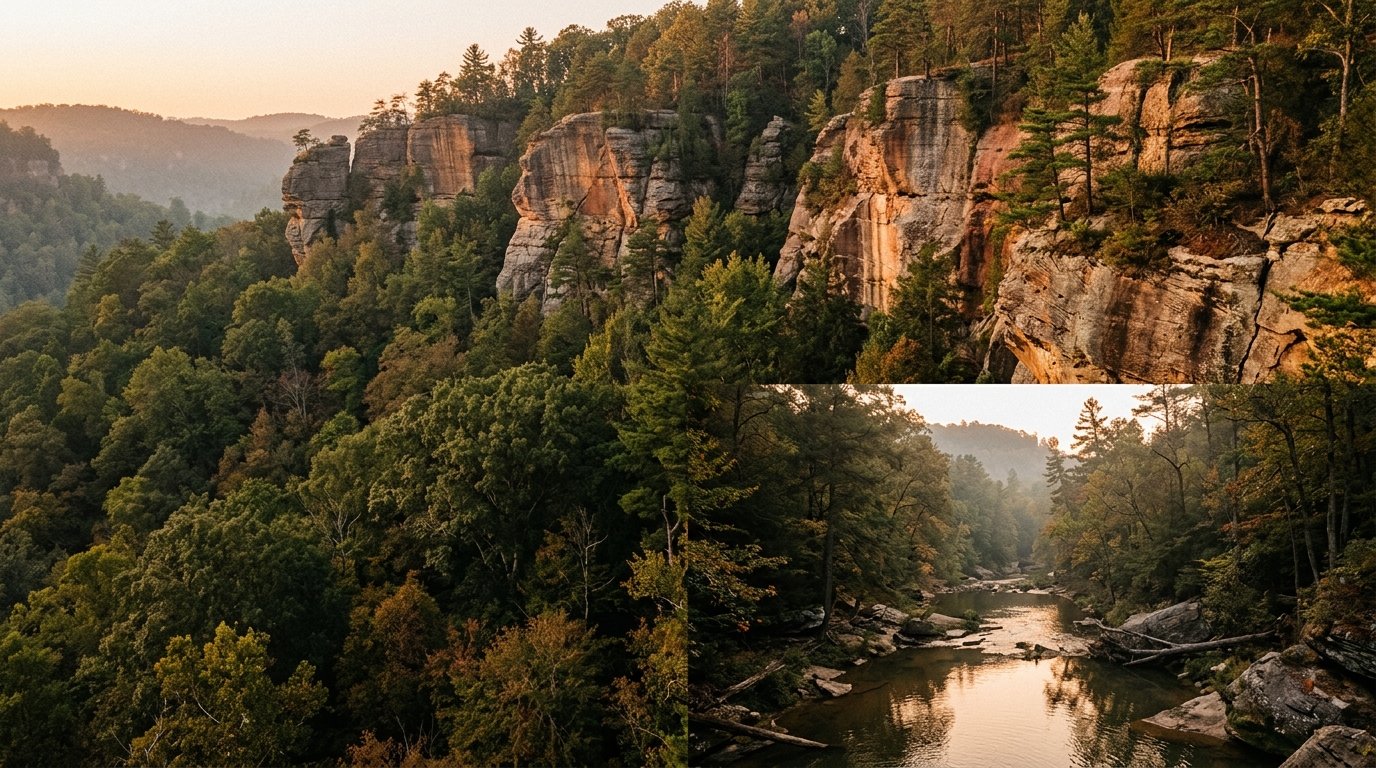
Hocking Hills is intimate: waterfalls, hemlock hollows, short iconic trails, with a famous winter-hike season that keeps cabins working in cold months. The Gorge is bigger and wilder: hundreds of sandstone arches, cliff lines that draw climbers from around the world, the Daniel Boone National Forest, and a spring-through-fall rhythm that peaks hard with October color. For guests it’s a genuine taste difference — postcard cozy versus raw and vertical. For owners it means seasonality curves differ, and your revenue expectations should follow the region you actually buy in, not a blended average.
Regulation posture
Neither market is a regulatory free-for-all anymore. Around Hocking Hills, growth brought tightening — townships and counties there have been formalizing rental rules, and anything you read ages quickly. On the Kentucky side, rules vary county by county along the corridor and are best described as developing; my county rules page tracks the landscape, and verifying current requirements directly with the county is a non-negotiable diligence step in either state. Buy assuming oversight increases everywhere, and let anything looser be upside.
So which one?
If you want proven demand you can underwrite from deep history, don’t mind paying the going rate for it, and drive from Columbus — Hocking Hills is hard to argue against, and I’d rather tell you that than pretend otherwise. If you want lower entry, bigger terrain, a growth thesis, and you’re coming from Cincinnati, Louisville, or Lexington, the Gorge case gets strong. I only work one of these markets, and I publish this site — weigh my perspective accordingly, then make me prove the Gorge case with dated numbers: (859) 310-1209.
Common Questions
Is the Red River Gorge just a cheaper Hocking Hills?
No — it’s a different product at a different market stage. The terrain is larger-scale, the climbing economy brings a visitor stream Hocking doesn’t have, and the rental market is younger. Cheaper entry has historically been part of the appeal, but buying the Gorge purely as a discount misreads what guests come here for.
Can I compare actual revenue numbers between the two markets?
Yes, but insist on dated, sourced data for both, from the same methodology, pulled the same month — occupancy and rate figures go stale fast and get quoted selectively. For the Gorge side, my market report carries current sourced numbers. For Hocking, request equivalent data rather than accepting listing-agent folklore.
Could I own in both markets?
Some investors do exactly that as a seasonality hedge — Hocking’s winter-hike season against the Gorge’s October peak. It doubles your management overhead and splits your attention across two rule environments, so it’s a second-property conversation, not a first one. A 1031 exchange can factor in; talk to your tax advisor.
Weighing other markets too? See Gatlinburg vs the Gorge and Broken Bow vs the Gorge.
Marcos Gil, REALTOR® · Keller Williams Commonwealth · Publisher of Invest in the Gorge · Based in Beattyville, working the whole Gorge corridor · Also owner of Central Property Services — any recommendation involving my other businesses is disclosed in writing. Not a mortgage loan originator; financing content is education, and loans come only from licensed lenders.
Compare with real numbers
Last updated: August 14, 2026