
What Is My Gorge Cabin Worth?
What is my Gorge cabin worth? Two ledgers decide it: the comps and the P&L. Kentucky agents — me included — are licensed and regulated by the Kentucky Real Estate Commission.
The Short Answer
A Red River Gorge cabin is valued on two ledgers at once: what comparable cabins have actually sold for, and what the cabin itself earns as a rental. Online estimators read neither one well out here. A written opinion of value works through both — recent sales adjusted for terrain and access, plus your booking history and operating costs — and lands on a defensible range rather than a single algorithmic guess.
Why a cabin is valued differently than a house in town
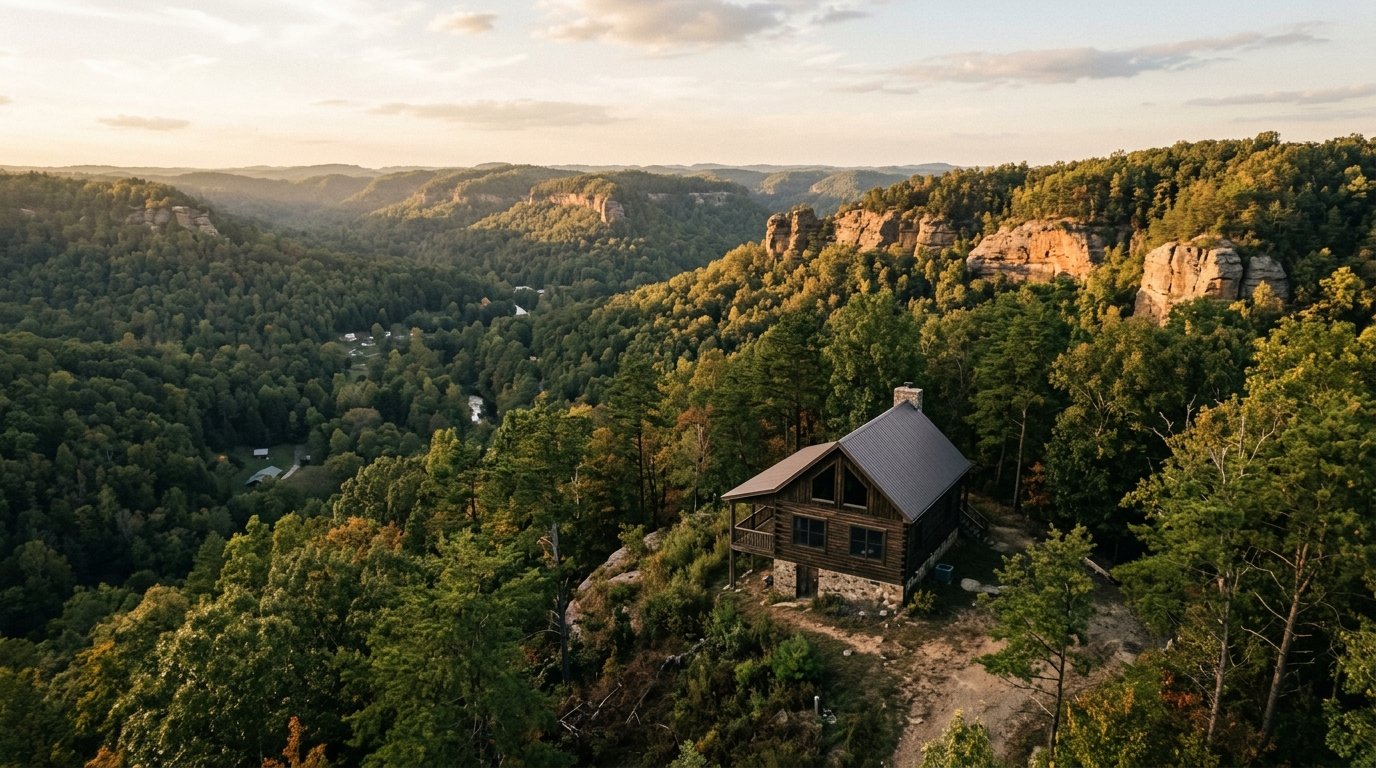
A subdivision house has a dozen near-identical comps within a mile. A Gorge cabin has almost none. One sits on a creek, the next on a ridgetop; one has deeded frontage on a county road, the next is a half mile up shared gravel. And unlike most houses, many cabins here are businesses — they carry booking calendars, reviews, and repeat guests. That is why serious valuation out here runs on two tracks: comparable sales, adjusted hard for terrain and access, and the property’s own profit-and-loss record. Either track alone can mislead you.
The P&L side of the answer
If your cabin rents, its operating history is evidence. Gross booking revenue over the trailing years, the platform mix, seasonality, cleaning and management costs, utilities, and maintenance all shape what an investor-buyer will reasonably pay. I don’t quote you a revenue multiple off a chart — short-term-rental performance in this market moves with season and county rules, so the numbers have to be yours, dated, and documented. The stronger and cleaner your records, the stronger the case your asking price can carry. Thin or informal records don’t kill a sale, but they do shift weight onto the comp side.
The comp side of the answer
True comps are scarce, so the work is in the adjustments: cliff-line views, creek or river frontage, proximity to trailheads and Natural Bridge, paved versus gravel access, acreage, septic capacity, and build quality all move value in ways a spreadsheet from another market would miss. I pull the sales that actually happened across the Gorge corridor — Slade, Stanton, Campton, Beattyville — and weigh each against your property feature by feature, noting where the data is thin so you can see the uncertainty instead of having it hidden from you.
Why online estimators miss out here
Automated estimates are trained on dense markets with uniform housing stock. They struggle with large or irregular parcels, private-road access, log and timber-frame construction, and they have no input at all for rental income. In the Gorge they routinely land far from what a cabin actually trades for — sometimes high, sometimes low, with no way to tell which. Use them as a curiosity if you like, but don’t anchor a sale, a refinance conversation, or an estate decision on one. A valuation here has to be built by hand, from local sales and your own books.
What my written opinion of value includes
You get a document, not a number over the phone: the comparable sales I used and how I adjusted each; a review of your income and expense records if the cabin rents; a defensible pricing range with the reasoning shown; condition items likely to surface in inspection, including septic, well, and access questions covered in my septic and wells guide; and a candid note on timing. Where pre-sale repairs would pay for themselves, I’ll say so — and disclose that I own Central Property Services, a repair company, so you can price that advice accordingly or use any contractor you choose.
How to request it
Call or text me at (859) 310-1209, or use the contact page. Helpful things to gather: your booking history export if the cabin rents, utility costs, any survey or septic records, and a list of improvements with rough dates. I’m Marcos Gil, REALTOR® with Keller Williams Commonwealth, based in Beattyville — I work this corridor daily rather than driving in for the appointment. There’s no obligation attached to the valuation; some owners use it to sell, others to decide to hold, and both are legitimate outcomes.
Common Questions
Does rental income really change what a cabin sells for?
It changes who your buyer is and what they can justify. Investor-buyers underwrite a cabin like a small business, so documented booking history gives them a reason to reach. But income claims must be provable — dated statements, not memory. And a second-home buyer may value the same cabin on entirely different grounds, which is why the comp side still matters.
My cabin has never been rented. Can it still be valued properly?
Yes. Plenty of Gorge cabins trade as personal retreats, valued on comparable sales, condition, land, and access. If rental potential is relevant to your likely buyer, I can describe it qualitatively and point to the sourced data on my market report — without inventing projections for a history that doesn’t exist.
Is the valuation the same as an appraisal?
No. A licensed appraiser produces an appraisal, typically for a lender. My written opinion of value is a broker’s pricing analysis built for a sale decision. They often land close together, but they serve different purposes, and if your situation needs a formal appraisal — estate, divorce, tax — I’ll say so and you should engage an appraiser.
When you’re ready for the next step, see how a Gorge cabin sale works and how I market a cabin once it’s priced.
Marcos Gil, REALTOR® · Keller Williams Commonwealth · Publisher of Invest in the Gorge · Based in Beattyville, working the whole Gorge corridor · Also owner of Central Property Services — any recommendation involving my other businesses is disclosed in writing. Not a mortgage loan originator; financing content is education, and loans come only from licensed lenders.
Request a cabin valuation
Last updated: August 14, 2026
Ask what your cabin is worth
Tell me a little about the property and I will come back with a real number and how I got to it.