Daniel Boone National Forest Guide
The federal forest that holds the Gorge — and what its border means if you own beside it.
The Short Answer
The Daniel Boone National Forest is the vast federal forest running down eastern Kentucky, and the Red River Gorge Geological Area sits inside it. For visitors, that means public trails, cliffs, and campgrounds managed by the U.S. Forest Service. For property owners, land bordering the forest has a federally owned neighbor that is not headed for subdivision, which makes views and privacy unusually durable — though boundaries and access always deserve verification before purchase.
The umbrella the Gorge sits under
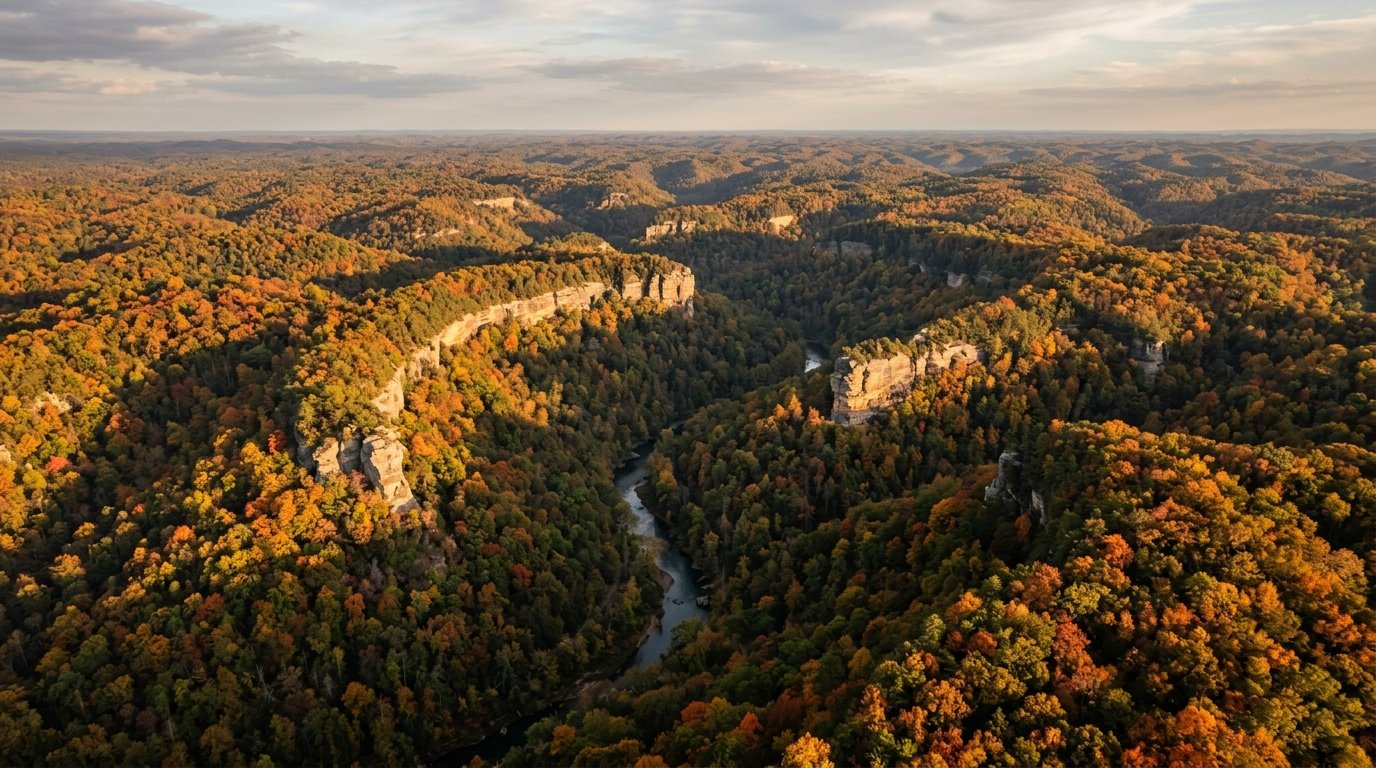
People say they are going to the Red River Gorge; on the map, they are entering the Daniel Boone National Forest. The Boone is the sprawling federal forest running down the eastern side of Kentucky, and the Gorge — formally the Red River Gorge Geological Area — is a designated area within it, alongside the adjoining Clifty Wilderness. The distinction matters practically: the U.S. Forest Service manages the trails, cliffs, campgrounds, and rules you encounter, and its current maps and alerts are the authority on access. Natural Bridge, by contrast, is a Kentucky state resort park surrounded by the forest — a separate system with its own rules.
What the designation actually means
A national forest is not a national park. Forests are managed for multiple uses — recreation, timber, watershed, wildlife — under federal ownership, which is why you will find both wilderness-grade backcountry and working forest roads within the Boone. For visitors the practical effects are generous: an enormous public trail network, dispersed camping under posted rules, and cliff country that remains open to the public rather than parceled behind gates. Rules on fires, camping distances, permits, and closures are set by the Forest Service and change seasonally, so treat current official information as the final word over any guide, including this one.
What a forest boundary means for property owners
Here is the ownership angle this site exists for: private land bordering the national forest has a neighbor that does not build. The forest side of the line is federally owned, managed as forest, and not headed for a subdivision, which makes an adjoining tract’s viewshed and privacy unusually durable compared with private-neighbor land anywhere else. The honest caveats: forest management is not wilderness preservation everywhere, boundary lines in old surveys deserve professional verification, and access easements across federal land are their own legal topic. Before buying boundary land, get a current survey and read my buying land guide — this is exactly where diligence pays.
Recreation breadth beyond the famous arches
The Gorge’s arches get the postcards, but the Boone’s recreation range is far wider: paddling, fishing, hunting in season under state regulation, backpacking loops in Clifty Wilderness, horse trails, and quiet drainages that absorb crowds the marquee trailheads cannot. For cabin owners this breadth is an underrated asset — guests who come for Gray’s Arch return for the backcountry, and a market fed by a forest this size is not dependent on one overlook’s popularity. My things to do page maps the highlights; the forest itself outlasts any list.
Reading this as an investor
Permanent public land is the quiet foundation under the Gorge property market: the draw cannot be duplicated by a competing development, and the supply of private land near it is inherently limited. That is a structural observation, not a return promise — demand, rules, and prices all move, and the market report carries the current sourced numbers. If the idea of owning beside a fixed wilderness appeals to you, start with the cabin investment guide, and remember the disclosure that applies across this site: I publish it and sell real estate here.
Common Questions
Is the Red River Gorge a national park?
No — it is a designated geological area within the Daniel Boone National Forest, managed by the U.S. Forest Service, with the Clifty Wilderness adjoining it. Natural Bridge nearby is a separate Kentucky state resort park. The management differences affect rules on camping, fires, and access, so check the right agency’s current information for wherever you are headed.
Can the forest next to my land ever be developed?
Federal forest land is managed as forest, not held for development, which is why boundary tracts are prized. But national forests are multiple-use lands — management activities like timber operations can occur — and nothing here is legal advice. Verify boundaries with a current survey and ask the Forest Service about management plans for the specific adjoining parcel before you buy.
Does bordering the forest guarantee trail access from my property?
No. Adjacency does not create a legal right to enter at any point you like, and building unofficial trails onto federal land can create problems. Access runs through established trailheads and any documented easements. Treat claimed private access to the forest as something to verify in writing during diligence, not something to assume from a listing description.
See what the forest offers visitors in things to do in the Gorge, and what boundary land involves in buying land in the Gorge.
Marcos Gil, REALTOR® · Keller Williams Commonwealth · Publisher of Invest in the Gorge · Based in Beattyville, working the whole Gorge corridor · Also owner of Central Property Services — any recommendation involving my other businesses is disclosed in writing. Not a mortgage loan originator; financing content is education, and loans come only from licensed lenders.
Text GORGE for the off-market list
Last updated: August 14, 2026