
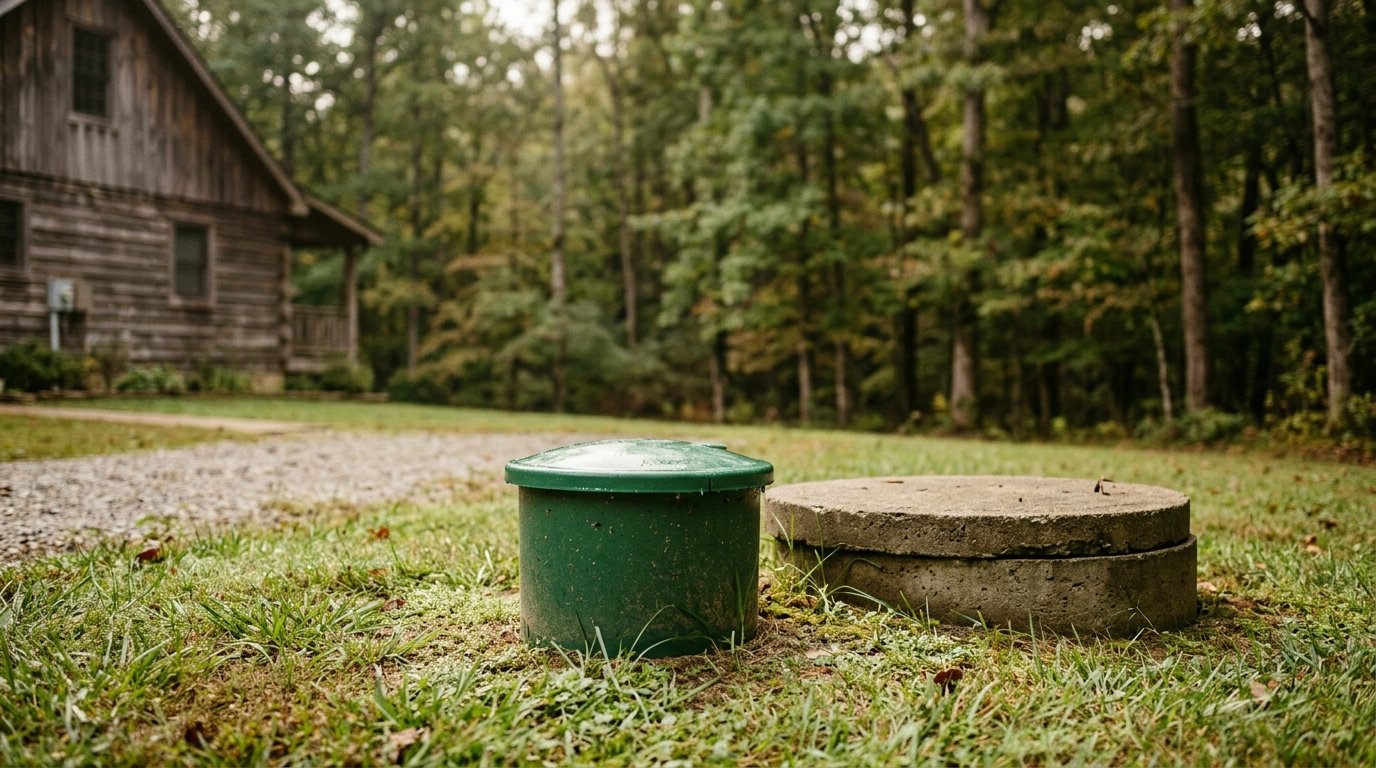
Septic & Wells for Gorge Properties
Septic systems and wells on Red River Gorge properties kill more rural deals than anything else. Kentucky’s Energy and Environment Cabinet publishes the state’s water-resources guidance.
The Short Answer
Most Gorge cabins run on private systems — septic for waste, a well, spring, or cistern for water — and these systems kill more rural deals than any other issue. Protect yourself with a dedicated septic inspection and a lab water test during diligence, pull whatever records the county health department holds, and match the septic system’s rated capacity against how many guests you actually plan to sleep. Replacement is expensive enough to renegotiate over.
Why this is the number-one rural deal-killer
City buyers assume water and sewer the way they assume gravity, and the Gorge corrects that assumption fast: outside the small town systems, nearly everything runs on septic and private water. A failing septic field or a compromised water source can cost more to remedy than almost any other single defect a cabin can hide, and neither announces itself on a sunny showing day. This is why I treat these two systems as the spine of rural diligence — before falling in love with the porch view, we establish what happens when you flush and what comes out of the tap.
The septic inspection, specifically
A general home inspection is not a septic inspection. You want a dedicated septic evaluation: tank located and opened, pumped if needed, baffles and lids checked, and the drain field assessed under load — not a glance at green grass. Ask when the tank was last pumped and where the field actually sits, especially on steep or rocky parcels where fields go in creative places. On raw land, whether ground even accommodates a system is a pre-purchase question my land guide covers. Expect the inspection to cost real money and schedule real lead time; both are cheap against what they can catch.
Wells, springs, cisterns — and the water test
Gorge properties draw water several ways: drilled wells, older springs, cisterns filled by catchment or hauling. Each can serve a cabin well, and each gets the same diligence: a laboratory water test — bacteria at minimum, and a broader panel where the source or plumbing age warrants — plus a check of pressure, recovery, and the equipment between source and tap. For rentals, understand that guests judge water instantly; sulfur smell or weak pressure shows up in reviews even when the water is safe. Treatment equipment exists for most problems; you just want to price it before closing, not after.
Do you need a permit to drill a well in Kentucky?
No. Kentucky requires no permit application or fee from the property owner to construct or abandon a water well — but the work itself must be done by a certified driller.
This surprises nearly every buyer who assumes rural water means red tape. The Kentucky Energy and Environment Cabinet states it directly: there are no permitting applications or fees for constructing or abandoning a water well required of the property owner. What the state does regulate is who may do the work. Construction, modification, and abandonment of wells in Kentucky must be performed by a Kentucky Certified Water Well Driller. The practical consequence for a land buyer is that the question to ask is never “did they pull a permit” — there is no permit to pull. It is “who drilled this, and were they certified.”
That leads to the document worth chasing. The Cabinet states that the driller completes and submits the required documentation for the well and supplies the owner a copy within sixty days of completing it. That paperwork is the closest thing to a birth certificate a well has, and it tells you depth, materials, and construction detail that no visual inspection will ever reveal. On an older Gorge parcel the record may be long gone, and that absence is not automatically a dealbreaker — but it does mean your water test and flow check are carrying the entire evidentiary load, and you should price that uncertainty rather than ignore it.
The Gorge-specific wrinkle: water and flooding
Here is where general Kentucky guidance becomes specifically a Red River Gorge problem. The Cabinet’s guidance for well owners in flood-prone settings includes raising the well casing at least twelve inches above the historic record flood level. In much of the state that is an abstraction. Along the drainages that feed the Red River it is a site-planning decision you can actually see on the ground, and it is worth walking the wellhead with the same eyes you would bring to the cabin itself. A well whose casing sits in a low spot near a creek is a contamination pathway during high water, regardless of how good the water tests today. This is the same terrain question that drives flood zone and insurance decisions on Gorge property, and the two diligence items are worth running together rather than separately.
On testing cadence, the Cabinet’s guidance is that homeowners using private wells or cisterns as their drinking water source should have the water tested annually, through a certified laboratory, for bacteria and other contaminants such as nitrates. Build that into your ownership budget from day one — it is a small recurring cost, and on a short-term rental it is also the record you will be glad to have if a guest ever raises a question. If you are still at the stage of comparing parcels rather than inspecting one, the broader groundwork is covered in our guide to buying land in the Red River Gorge.
The county health department’s role
In Kentucky, on-site sewage systems run through the local health department — permits for new and replacement systems, records of existing ones, and the rules for what a parcel’s soil and slope will support. During diligence, requesting whatever file exists on your property is free intelligence: it can reveal the system’s age, design capacity, and past problems. On land, the health department is where perc-and-site evaluation questions get answered before you commit. Requirements and processes vary by county along the corridor, so verify locally each time rather than assuming the last county’s answer travels.
Replacement-cost awareness, without fake numbers
I won’t quote replacement prices here — they swing with soil, slope, system type, and the year you’re reading this — but the honest qualitative statement is that a full septic replacement is one of the most expensive single repairs a rural property can demand, and difficult sites can push it further. That scale is exactly why a failed inspection is a renegotiation event, not a shrug. Get current local quotes during diligence if problems surface, and weigh them against price. Disclosure where repair talk arises: I own Central Property Services, a repair company; quotes should come from whoever you choose.
STR honesty: occupancy versus septic capacity
Septic systems are designed around bedroom counts, and short-term rentals are where that design meets temptation: a system sized for a small household, asked to process a different reality every weekend because the listing sleeps twelve. Chronic overload shortens a field’s life and can end in exactly the expensive failure described above — sometimes mid-booking. If your plan is a rental, match your advertised sleeping capacity to what the system is rated to handle, and let that number discipline the listing. My investment guide and maintenance guide both fold this into the underwriting.
Common Questions
The listing says the septic “works fine.” Is that enough?
No. “Works fine” usually means “has not visibly backed up,” which says nothing about tank condition or field life. Sellers often genuinely don’t know — many have never seen their own tank opened. A dedicated inspection converts folklore into findings, and it’s standard in my offers on septic properties, not an insult to anyone.
Can I add bedrooms or sleep more guests than the septic is rated for?
Adding bedrooms typically triggers health-department review of system capacity, and advertising sleeping capacity far beyond the system’s design is a risk you carry — to the field’s lifespan and, for rentals, to your operation if problems or complaints surface. Verify with the county health department before renovating or listing; rules and enforcement vary by county.
What water test should I order during diligence?
Bacteria testing is the floor. Beyond that, the right panel depends on the source — wells, springs, and cisterns each have characteristic risks — and on plumbing age. Your inspector or the local health department can point to an appropriate lab panel. Order it early; results take time, and you want them inside your diligence window.
Pair this with access, easements, and surveys — the other half of rural diligence — and the cabin buyers starter kit.
Marcos Gil, REALTOR® · Keller Williams Commonwealth · Publisher of Invest in the Gorge · Based in Beattyville, working the whole Gorge corridor · Also owner of Central Property Services — any recommendation involving my other businesses is disclosed in writing. Not a mortgage loan originator; financing content is education, and loans come only from licensed lenders.
Get the diligence checklist
Last updated: August 14, 2026
Last updated: August 29, 2026