Gorge Journal · Land & Timber
Look at the stumps. If the widest, straightest stumps are gone and the crooked trees are still standing, that Red River Gorge tract was high-graded, not thinned.
Plenty of land in and around the Red River Gorge comes to market shortly after a timber harvest, and the listing photos rarely say so. A wooded hillside photographs as a wooded hillside whether it holds a full stand of mature hardwood or the leftovers of a cut that took every valuable tree on the property eighteen months ago. The difference does not show in a drone shot. It shows in the stumps, the skid trails, and the paperwork — and it is worth understanding before you write an offer, because the trees are often the largest single asset on a rural Kentucky tract.
What does a recently logged tract actually look like on the ground?
Fresh stumps, compacted skid trails running downhill, a flat cleared area where logs were stacked, and tree tops left on the ground where they fell.
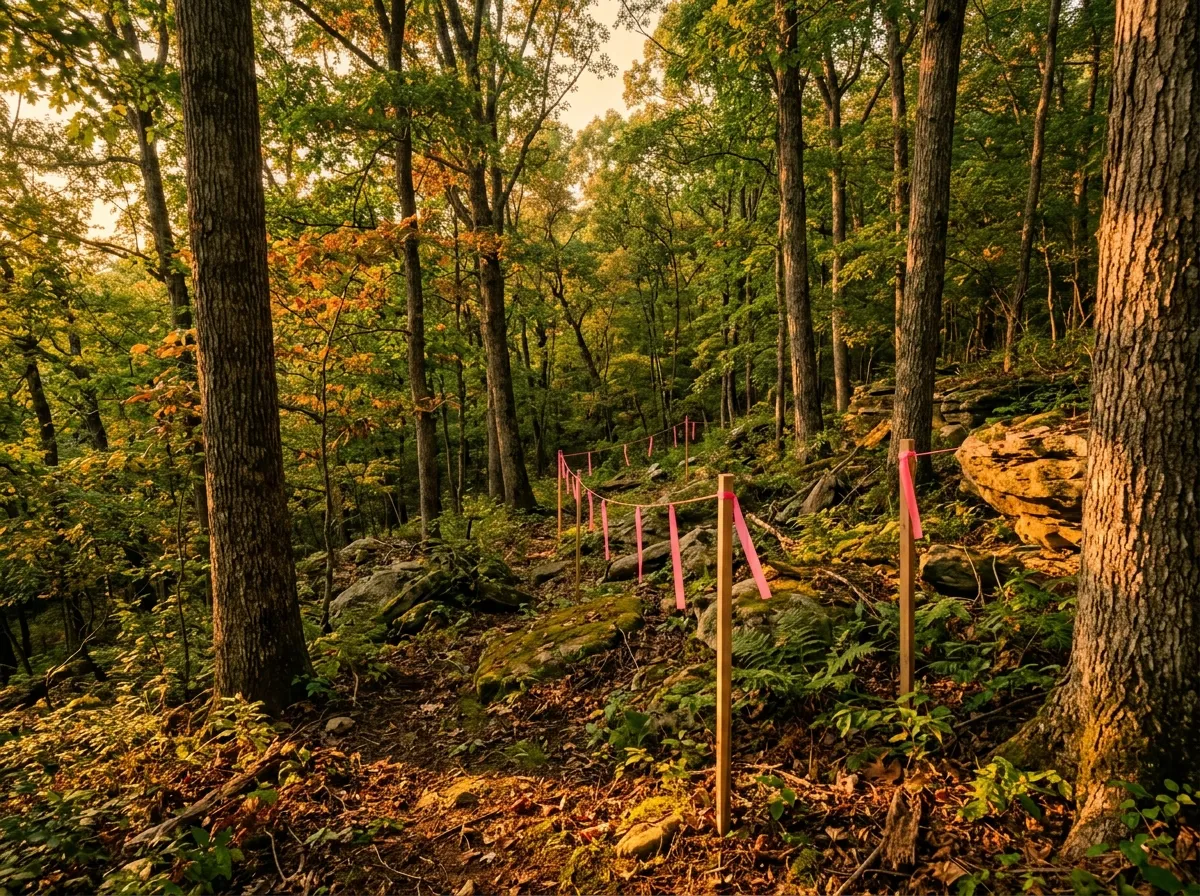
Walk the tract and read those four things in order. Stumps tell you what was taken and roughly when — a cut face that is still pale and sharp-edged is recent, one that is grey, checked and growing fungus is older. Skid trails are the routes the equipment used to drag logs out; on Gorge terrain they run down the slope and they stay where they were put for years. The log landing is the flat spot near the road access where logs were decked and loaded, usually the most compacted ground on the property. Tops and limbs left in place are normal practice rather than evidence of anything wrong, but they tell you the harvest was recent enough that they have not yet broken down.
None of that is hidden. It simply requires walking past the part of the property you can see from the road, which is the part the photographs were taken from.
What is high-grading, and why should a buyer care?
High-grading means taking the best trees and leaving the worst. It is legal, common, and it lowers what the woodland is worth for decades afterward.
The term is not ours. University of Kentucky Forestry and Natural Resources Extension defines it plainly: “Taking the very best and leaving the rest is called ‘high-grading’ and can lower long-term timber value.” The same page notes that Kentucky as a whole is not being overharvested — the state grows more than twice the sawlog volume it removes, and woodland area has increased over 3 percent in the last 70 years — but that higher quality trees are much more likely to be harvested than lower quality ones. The pressure is species-specific: of the 821 million board feet harvested statewide in 2015, more than half the volume came from oaks, with white oak alone accounting for 16 percent.
For a buyer, that turns an abstract forestry concept into a concrete question about the parcel in front of you. A thinned stand has had poor and crowded trees removed so the good ones can grow; the remaining trees are straight and well-formed. A high-graded stand has had the opposite done to it, and what is left standing is the genetic and structural material that will regrow the woodland. Both look green in July.
A high-graded tract and a well-managed one photograph identically. The stumps are the only honest part of the listing.
| What you see | Points toward a thinning | Points toward a high-grade |
|---|---|---|
| Stump diameters | Mixed, many small and medium | Consistently large |
| Trees left standing | Straight, well-formed, evenly spaced | Crooked, forked, damaged, or low-value species |
| Canopy after the cut | Gaps opened around retained crop trees | Best crowns gone, remaining canopy patchy |
| Species removed | A range, including culls | Concentrated in oak and other high-value timber |
Was the harvest required to be run by a certified logger?
Yes, for commercial harvests in Kentucky since July 15, 2000. A trained Master Logger must be on site and in charge of the operation.
The Kentucky Master Logger Program was developed in 1992 by the University of Kentucky Department of Forestry Extension together with the Kentucky Forest Industries Association and the Kentucky Division of Forestry. Attendance was voluntary from 1992 through July 15, 2000. On that date the Kentucky Forest Conservation Act took effect, and per UK Forestry Extension it requires all logging operations to have one person on site and in charge who has successfully completed the three-day program. That course covers best management practices for logging operations, an industry update, OSHA regulations and procedures, safety and fatality material, and chainsaw safety and felling techniques.
UK Extension also publishes FOR-130, a field guide written to help logging operations meet the mandatory best-management-practice minimum requirements for water quality protection. The existence of a mandatory BMP floor is the useful fact for a buyer: whether a particular harvest met it is a question you can ask, and the answer has physical consequences you will inherit.
Why does a poorly run cut become the next owner’s problem?
Because the land keeps the damage. Rutted skid trails, an eroding landing, and a stream crossing left in poor condition stay on the property after the logger and the seller are gone.
Gorge-region terrain makes this sharper than it would be on flat ground. Slopes here are steep, soils are thin over sandstone in many places, and water moves fast. A skid trail cut straight down a hillside becomes a channel the first time it rains hard, and that channel is what you will be driving, mowing, or building around later. If you were planning to use an old skid road as your driveway alignment — a reasonable instinct, since it is already cleared — walk it during or right after a rain before you assume it works.
In practice, the professional habit that saves buyers the most trouble on rural tracts is simple and unglamorous: go back a second time in bad weather. A dry-day walk tells you what a property looks like. A wet-day walk tells you what it does. Almost every consequential surprise on a wooded Kentucky parcel — access, drainage, erosion, the real condition of a crossing — reveals itself in the second visit rather than the first, and the inspection period exists precisely so you can take it.
What should you ask before you write the offer?
Ask when the tract was last harvested, who ran it, whether a written timber contract exists, and whether the timber rights are still attached to the land.
- When was the last harvest? Ask for the date, not the decade. Then check it against what the stumps show you.
- Was there a written timber sale contract, and can you see it? A contract will name the operator and describe what was to be cut.
- Was a Master Logger on site and in charge? This has been the legal requirement for commercial operations since July 15, 2000.
- Do the timber rights convey? Timber can be sold separately from the land by timber deed, or committed under a harvest contract whose term outlives your closing. We cover that separately in our guide to mineral and timber rights on Gorge land.
- Is any part of the tract under an agreement that restricts future cutting? A recorded conservation easement can limit harvesting permanently, which may be exactly what you want or exactly what you do not.
- Where does the tract sit relative to public land? Boundary and access questions change if you adjoin Daniel Boone National Forest.
Frequently asked questions
Does a recent harvest make a tract a bad buy?
Not necessarily. It changes what you are buying and when the woodland will be worth something again. A cut-over tract bought as a homesite, a recreation property, or a long-hold investment can make complete sense. The mistake is paying for standing timber that is no longer standing.
How long does it take a high-graded Kentucky woodland to recover?
Long enough that it is a generational question rather than a holding-period one, and it depends on site quality, what was left standing, and what regenerates. UK Forestry Extension notes that white oak in particular is increasingly difficult to regenerate, especially on better quality sites. Talk to a consulting forester about your specific tract rather than relying on a general number.
Can I tell from public records whether a property was logged?
Sometimes. A timber deed or a severance of timber rights is a recorded instrument and will turn up in a title search. A routine harvest sold under a private contract usually will not be recorded at all, which is why the physical walk and a direct question to the seller matter.
Last updated: September 10, 2026
By Marcos Gil, REALTOR® — Keller Williams Commonwealth · KY Real Estate License No. 296259 · Call or text (859) 310-1209.
Leave a Reply